

It’s almost time to file your taxes! And the most common question we get every year is, “When will I get my tax refund?” Most people get their IRS tax refund within 21 days of filing, but the exact timeline depends on when your return is accepted, how you submit, and whether you claim certain tax credits. IRS Tax Refund Calendar and Schedule 2026 .
The IRS will start accepting e-File on January 26, 2026, and the first direct transfers will be made by mid-February. As required by law, returns that include the Earned Income Tax Credit (EITC) or the Additional Child Tax Credit (ACTC) will not be processed until after February 15.

Based on when the IRS accepts returns and when people want their checks sent, the College Investor’s yearly IRS Tax Refund Calendar below shows when the money will be deposited and when checks will be mailed. These are guesses, not promises, but they are quite near to the genuine refund data that our readers send us every year.
2026 IRS Tax Refund Schedule Chart
Here is a chart of when you can expect your tax refund for when the return was accepted (based on e-Filing). This is an estimate, but based on past information, does seem accurate for about 90% of taxpayers. Also, as always, you can use the link after the calendar to get your specific refund status.
When can you file your 2025 federal tax return in 2026? Filing season is anytime between January 26 and April 15, 2026.
Now, when to expect my tax refund based on when it’s accepted!

Note: The IRS sends direct deposits to bank accounts every business day during tax season. Our goal is to provide the end of the week in which you should hopefully receive your tax refund.
What If You File A Tax Extension In 2026?
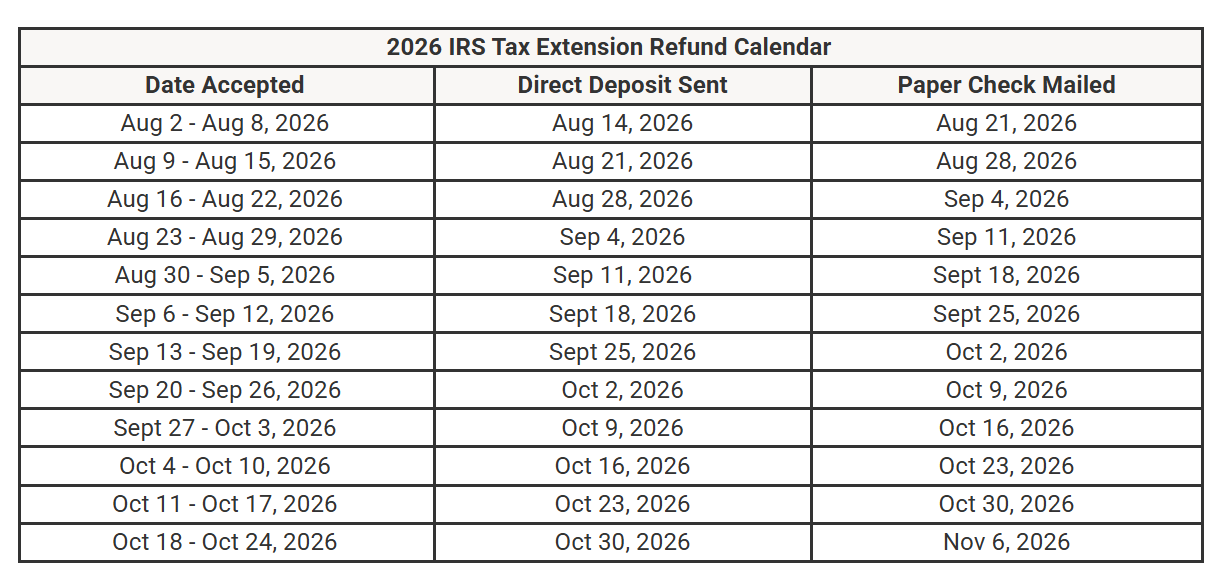
If you file a tax extension in 2026, you can extend your personal tax deadline until October 15, 2026. Remember, if you choose to file a tax extension for your Federal tax return, you are still required to pay any taxes you may owe by the April deadline. If you are expecting a tax refund, that doesn’t really matter – but you still need to file to claim your refund.
Here’s a modified tax refund calendar specifically for those who filed a tax extension. We didn’t want to clutter the above chart given the dates for filing an extension are typically 6 months later. However, the rule of 21 days on average still applies if you file a tax extension and claim your refund later.

What’s New For 2026?
The big change for 2026 is the likely delayed start to tax season. At the Tax Summit of the National Association of Enrolled Agents in Salt Lake City, IRS Commissioner Billy Long said the start of the 2026 tax season should be around Presidents Day, which is February 16. However, the IRS announced on January 8, 2026 that the start of tax season will begin on January 26, 2026 – a day earlier than last year.
We are still concerned that it could be a slower tax year this year. When you combine that with the government shutdown and the massive changes required to implement the OBBBA, we worry the date could not be reflective of the actual process.
IRS Processing Timeline Explained
The IRS typically issues most refunds within 21 days of accepting your e-filed return. That 21-day clock doesn’t start when you file your taxes – it begins once the IRS officially accepts your return for processing.
Here’s what happens at each stage:
1. Return Accepted → IRS Starts Processing
Once you hit “Submit,” your tax return is time-stamped and transmitted to the IRS. Within 24 to 48 hours, the agency verifies your personal information and either accepts or rejects the return.
An “Accepted” status means your filing passed basic validation checks and entered the IRS processing system.
Notice: If you submit your tax return before eFile opens (which many online tax software services allow), these companies will hold your return and then submit as soon as the IRS begins accepting them. Some lucky filers may get early access in test batches as well.
2. Refund Approved → Deposit Date Set
After your return clears initial verification, the IRS confirms your refund amount and approves payment.
This step triggers a deposit date, which appears in the “Where’s My Refund?” tool or the IRS2Go mobile app.
3. Refund Sent → Money in Your Account or Check Mailed
Once your refund is sent, it typically takes one to five business days to appear in your bank account.
Paper checks can take longer, depending on U.S. Postal Service delivery times and holidays.
How “Where’s My Refund?” Updates
The IRS updates refund statuses once per day—usually overnight.
You won’t see more frequent changes by checking multiple times a day.
You won’t see more frequent changes by checking multiple times a day.
Visit the official IRS tool here: Where’s My Refund?
If you’re getting an error message or issues, check out our full IRS Where’s My Refund Guide And Common Questions.
Early Filers: Expect A Delay In Your Refund
We expect the tax season to be extra delayed in 2026 – due to the IRS commissioner’s comments, changes to tax rules, and the government shutdown.
If you claimed the Earned Income Tax Credit (EITC) or the Additional Child Tax Credit (ACTC), federal law requires the IRS to hold your entire refund until at least mid-February.
For 2026, we expect the IRS to release the first wave of EITC/ACTC refunds to be by February 27 through March 6, provided there are no issues and you used direct deposit.
⚠ Reminder: Claiming the EITC or ACTC means no refunds before February 15, even if your return was accepted early. “Where’s My Refund” should show updates for most early filers by February 22, 2026.
There are other reasons for delays as well.
Paper Returns
Paper-filed returns take the longest to process because IRS staff must manually enter and verify information. Expect six to eight weeks for processing and mailing (at least), compared with 21 days for e-filers.
Errors or Identity Verification
Even small mistakes (like a misspelled name, incorrect Social Security number, or mismatched W-2 income) can cause delays.
The IRS may also flag your return for additional identity verification if it suspects potential fraud.
Bank Account Issues
If the direct-deposit information on your tax return is wrong, or if your bank account is closed, your refund may be delayed or rerouted as a paper check.
Check that your routing and account numbers are correct before submitting your return.
IRS Review Flags or Offsets
Your refund can also be reduced or held for past-due federal or state taxes, child support, or defaulted federal student loans. Yes, collection activity on student loans resumed – so the IRS will take your tax refund this year if you are in default.
Offsets are handled by the Treasury Offset Program (TOP). If this happens, you’ll receive a mailed notice explaining how your refund was applied.
How To Track Your Tax Refund
Once your return is accepted, you can track progress using IRS tools and your bank’s alerts. Here’s how to check safely and effectively:
IRS “Where’s My Refund?” (Web + App)
The fastest way to get accurate information.
Enter your Social Security number, filing status, and exact refund amount to see your personalized status.
Updates post once daily, typically overnight.
IRS2Go Mobile App
This free IRS2GO app mirrors the same data as the website but adds push notifications.
Download it from your device’s app store to get real-time updates without visiting the IRS site directly.