
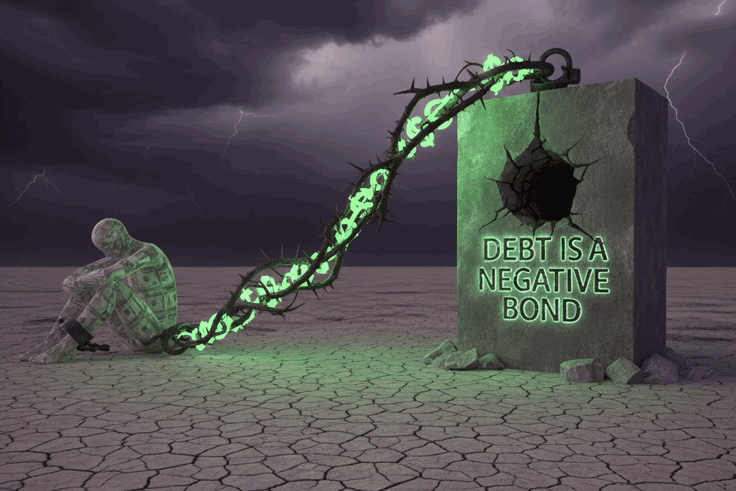
If you’ve been in the personal finance and investment world for a while, you’ve probably heard the saying “Debt is a negative bond.” Today we’re going to talk about what it implies and how it will affect your money and how you build your portfolio.
The main idea is quite simple. Let’s say you have a student loan for $100,000 and an investment in a stock index fund for $200,000. You have a net worth of $100,000. How do you divide up your assets? A lot of people would answer “100% stock,” but that’s not technically correct. You are really 200% stock. This is the classic argument against people who like portfolios with 100% stocks. If 100% stocks and 0% bonds is the optimal mix, why not 120% stocks or 200% stocks? A bond acts as “ballast” for a portfolio, making it less likely to be hurt by stock market drops. On the other hand, debt does the opposite. That leverage makes returns bigger, both good and bad. If you have $200,000 in stocks and $100,000 in debt and the market collapses by 50%, your net worth goes from $100,000 to $0. You are done. If the market doubles, your return is not 100%, but 200% because your net worth has gone from $100,000 to $300,000.
Paying down debt is just as good (and usually better) for returns as investing in bonds. It doesn’t make much sense to buy bonds that yield 1–2% interest when you have a school loan that costs 5% or a credit card that costs 15%. Paying off your credit card is arguably the finest thing you can do with your money. Paying off that school debt is definitely better than buying a bond fund, CD, or something like that. If you have a 5% debt that you can’t deduct, paying it off gives you a risk-free return of exactly 5% after taxes. That’s not bad at all.
Why Hold Bonds When You Have Debt?
So why does anyone with debt ever use bonds? Well, there are a few reasons.
1 They Don’t Know
Some folks don’t know that debt is a bad bond. Not knowing isn’t always a good thing. If you don’t know, you might create a stock/bond portfolio that looks good and overlook the debt as “something else.”
2 Different Pots of Money
This is the main reason I kept buying bonds even though I was in debt. I have a distinct mix of assets for each of my financial goals. My retirement portfolio, for instance, is made up of 60% stocks, 20% bonds, and 20% real estate. All of my kids’ college investments and UTMAs are in stocks. Their retirement accounts are split 90/10. I have 100% cash in my short-term savings. In that sense, my “pay off the house money” was mostly negative bonds, but there was a year or two when long-term readers may remember that we had both the mortgage and some stock index funds set aside for that purpose. Another smart individual would see all of their money (retirement money, college money, short-term savings money, etc.) as one big pot and have one big asset allocation for it. You might not have any bonds at all until you’ve paid off all your debts if you do so. It’s all about how you look at it.

3 Can’t Tolerate Volatility
One of the reasons that people put bonds in their portfolio is to act as a diversifier for stocks. Often, when stocks go down, bonds, particularly very safe bonds like treasuries, go up in value, offsetting your loss. This effect, combined with the fact that you have less of the portfolio in stocks, provides ballast to the portfolio, moderates its returns, and helps you to avoid panicking and selling low. It might sound dumb to sell low when I write it and you read it, but every time there is a market downturn I see doctors panicking and selling low, even relatively financially literate ones. Long treasury bonds perform this function best, but come with their own risks given their very long duration–they can have big losses in times of rising interest rates and are particularly susceptible to inflation, so most people stick with short to medium term bonds.
4 Bonds Provide Income
Some people have, at least in the past, acquired bonds to make money. Andrew Mellon is noted for saying, “Gentlemen prefer bonds.” A lot of retirees prefer having the money from bonds and dividends to help them spend their money. Of course, they might “declare their own dividend” by selling shares at any moment. A lot of people enjoy “multiple streams of income” or “passive income” to help pay for some of their bills, even when they are working. This used to be an excellent reason to buy bonds, but it’s probably not a good reason now. I mean, when I first started investing, between the Tech Stock Meltdown of 2000–2002 and the Global Financial Crisis of 2008, I could get as much as 5.25% on cash in a money market fund and bonds that paid the same or more. But we haven’t seen yields like that in a long time. So this isn’t a very good argument to buy bonds right now. By the way, paying off debt (not simply paying it down) also helps your cash flow.
5 Something To Sell When Stocks are Down
Jonathan Clements wrote an article not too long ago saying that this might be the only justification to keep bonds at these low interest rates. For someone who is still working and has an emergency savings and the right insurance plan, this isn’t as important. In short, you can just sell the bonds if you need money when the stock market goes down.

6 There’s a Chance Bonds Outperform Stocks
Finally, there is always a chance that bonds will do better than equities. While expected returns on stocks are higher, especially over very long periods of time, you don’t always get expected returns. There have been three long stretches of time (10 to 15 years) in the last 100 years (the 1930s, the 1970s, and the 2000s) when bonds did better than stocks. There is no rule that says those times couldn’t have been longer, or even that they couldn’t last your whole career as an investor. Having some bonds in your portfolio protects you against that risk.
Know why you’re buying bonds, and remember that debt is just a bad bond. Paying it off is often your best fixed-income investment and sometimes your best investment of any kind.
What do you think? Do you have debt when you buy bonds? Why or why not? Do you think of your debt as a bad bond? Leave a comment below!