
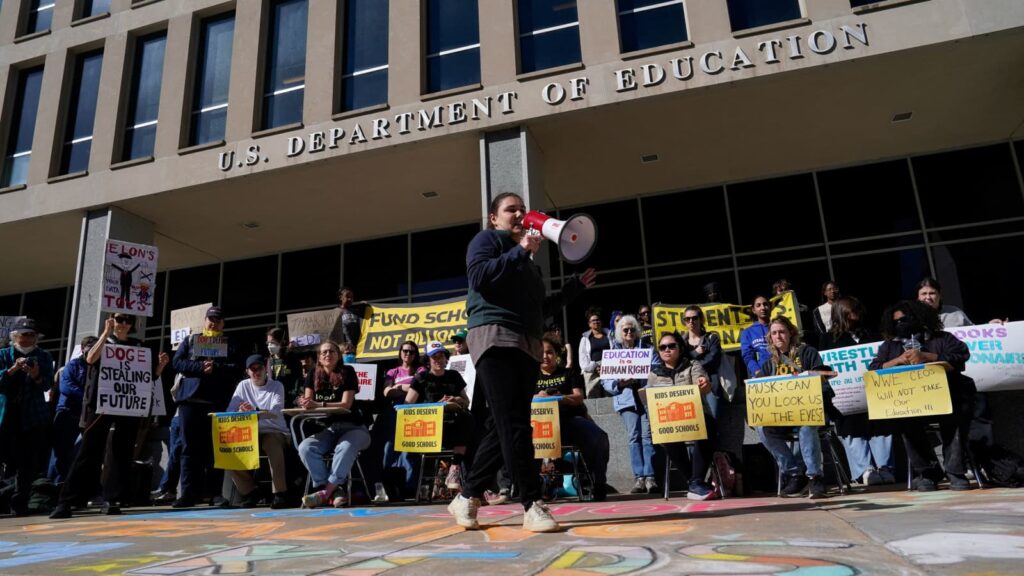
Key Points on Trump Asking Supreme Court
- The Trump administration has asked the Supreme Court to lift a lower court order blocking mass layoffs at the Department of Education. Trump Asks Supreme Court
- A federal judge previously halted plans to terminate over 2,100 employees, calling the move an illegal attempt to dismantle the agency.
- The case could determine whether a president can effectively eliminate federal departments without new legislation. Trump Asks Supreme Court
The Trump administration formally asked the U.S. Supreme Court this week to lift a federal court order that blocks its attempt to lay off more than half the staff at the Department of Education. If successful, the move would clear the way for up to 2,100 employee terminations and a sweeping transfer of responsibilities to other agencies. Trump Asks Supreme Court
The court filing (PDF) argues that the president has broad constitutional authority to reorganise the executive branch, including deciding which employees are necessary to carry out legal duties. Trump Asks Supreme Court

Move from lack to abundance 👇👇👇
Get $20k USD Cashapp Transfer Hack Click here
Get $5k USD Paypal Transfer Hack Click here
“The Constitution vests the Executive Branch, not district courts, with the authority to make judgements about how many employees are needed…” the administration wrote in its appeal. The request follows earlier denials from both a federal trial court and the First Circuit Court of Appeals, which had ruled the mass layoffs illegal.
This marks the 17th emergency appeal to the Supreme Court from the Trump administration since January, part of a broader strategy to reshape federal agencies through executive actions rather than new laws. It also marks the first major Supreme Court case centered on a president’s authority to effectively close an agency that Congress created. Trump Asks Supreme Court
Closing The Department Of Education
The administration’s plan began in March, when Education Secretary Linda McMahon announced a reduction-in-force order to eliminate roughly 2,100 of the department’s 4,100 staff. Two days later, President Trump signed an executive order instructing her to “take all necessary steps” to shut the department down, citing goals of reducing bureaucracy and improving efficiency. Trump Asks Supreme Court
The layoffs affected nearly every division, including Federal Student Aid, Civil Rights enforcement, and Title I grant distribution. Later, internal memos disclosed the disbandment of entire offices responsible for managing FAFSA applications and loan servicing contracts.

You did not see this today by mistake. Claim Your Financial Freedom
Get $50k USD Zelle Transfer Hack
Get $50k USD Paypal Transfer Hack
Get $20k USD Western union Transfer Hack
Get $50k USD Venmo Transfer Hack
Get $500k USD Money Transfer Hack
Trump told reporters that student loan servicing would shift to the Small Business Administration, while oversight of special education programmes would move to the Department of Health and Human Services.
The response was swift. Twenty-one states, joined by school districts and labour unions, filed lawsuits to stop the closures, arguing that the federal government had a duty to carry out education programmes established by Congress. Without staff, those mandates would go unmet. Trump Asks Supreme Court
U.S. District Judge Myong Joun issued a preliminary injunction in May, writing that the administration’s actions showed a clear attempt “to effectively dismantle the Department without an authorising statute.” He ordered the reinstatement of terminated workers and froze any further staffing changes. Trump Asks Supreme Court

It’s also become apparent that fulfilling Congressionally mandated work is becoming a challenge. The annual Report on the Condition of Education was published late this week, missing the June 1 deadline required by Congress, and was basically a summary – not a full report.
Legal Battle Heads To The Supreme Court
The Trump administration now seeks to overturn that ruling, asking the high court to weigh in on whether a president has the unilateral authority to reorganise or effectively eliminate executive agencies. If the Supreme Court grants the request, layoffs could resume almost immediately.
The Justice Department argues that the district court overstepped its authority by blocking the executive branch from managing its personnel. The administration argues that the president, not federal judges, should make decisions about staffing levels and internal structure. Trump Asks Supreme Court

Financial Freedom begins with a decision
Get $5k USD Paypal Transfer Hack Click here
Get $10k USD Zelle Transfer Hack Click here
Get $10k USD Venmo Transfer Hack Click here
But the states that are suing say the issue is not about management; it’s about legality. Congress created the Department of Education in 1979 and assigned it specific functions under federal law. Any effort to eliminate those responsibilities, they argue, must come through legislation.
Judge Joun appeared to agree. “A department without enough employees to perform statutorily mandated functions is not a department at all,” he wrote in his opinion. “This court cannot be asked to cover its eyes while the department’s employees are continuously fired and units are transferred out until the department becomes a shell of itself.” Trump Asks Supreme Court
What This Means For Students And Families
Beyond the legal fight, the real-world impact of this case touches millions of families and students. The Department of Education oversees more than $1.6 trillion in federal student loans, administers Pell Grants, monitors civil rights compliance in schools, and manages federal education funding across the country.

School districts in Massachusetts and other states say the layoffs have already caused missed payments, delayed grant approvals, and a breakdown in compliance systems. Some have had to scale back special education and summer school programs due to uncertainty over federal funding. Trump Asks Supreme Court
If the Supreme Court allows the cuts to go forward, many of those services could face long-term disruption. If the court blocks the layoffs permanently, the administration may need to change course and work with Congress to make any major restructuring legal.
Either way, families are starting to be concerned about financial aid for this fall.

Do not depend on single income; get access to this income source
Get $10k USD Zelle Transfer Hack Click here
Get $20k USD Cashapp Transfer Hack Click here
In the meantime, the Education Department remains in a holding pattern. The court’s decision, expected this summer, will determine whether the agency continues its current work or begins a shutdown that would affect everything from loan servicing to classroom funding. Trump Asks Supreme Court.