
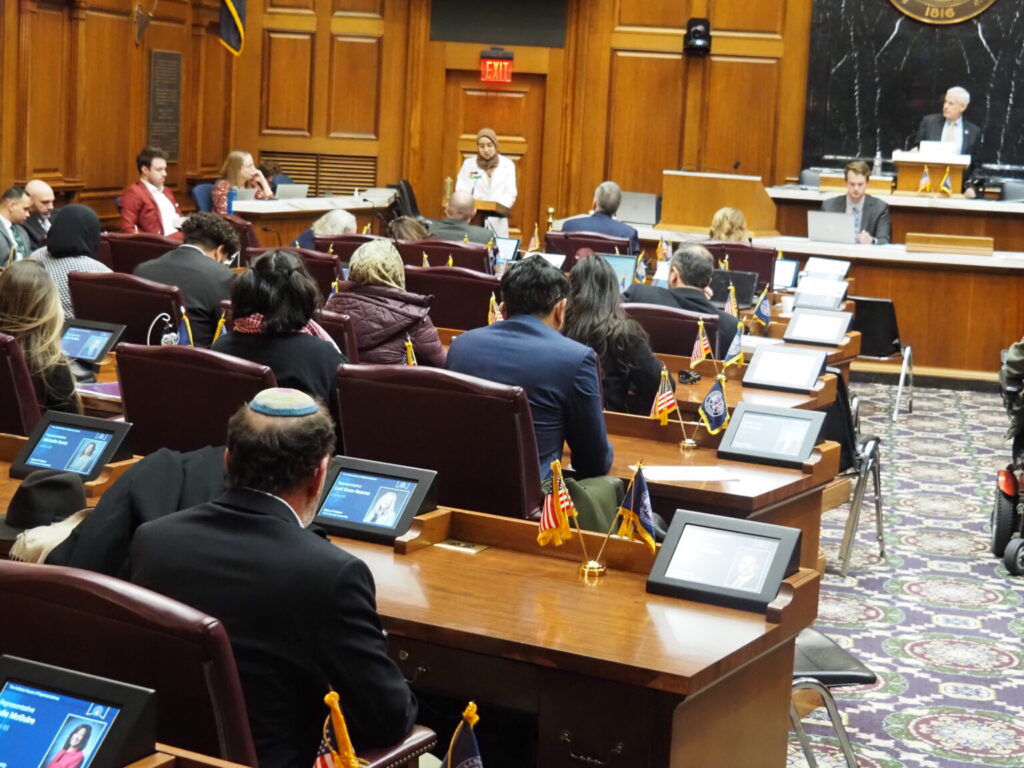
Rep. Mike Lawler (R-N.Y.) and a few other House Republicans presented the Professional Student Degree Act. It would add more degrees to the list of those that are considered “professional” under federal law. If the amendment goes through, students in many graduate programmes will be able to borrow up to $200,000 in direct federal loans. This is twice as much as the current limit. New Bill Would Expand Definition
The suggestion comes as trade groups and students in the industry have spoken out against the new loan limits. The One Big Beautiful Bill Act from last year says that new borrowers would no longer be able to get Grad PLUS loans starting on July 1, 2026. New Bill Would Expand Definition

Move from lack to abundance 👇👇👇
Get $20k USD Cashapp Transfer Hack Click here
Get $5k USD Paypal Transfer Hack Click here
There will be new limits on Graduate Direct Loans instead of the old ones that let you borrow as much as you want for grad school. The only thing that matters is whether a program is labelled “graduate” or “professional.”
Why The Professional vs. Graduate Definition Matters
Graduate programs have always had this classification, but prior to the OBBBA, it was only used for statistical purposes.
Beginning in 2026, those definitions are being used to limit borrowing under the Direct Loan Program:
- Graduate students (for masters and most doctoral programs):
$20,500 per year, with a $100,000 lifetime limit. - Professional students (such as law and medical students):
$50,000 per year, with a $200,000 lifetime limit.
The policy goal behind the change was to keep debt loads more closely aligned with earnings while maintaining higher limits for degrees that typically lead to high-paying careers. New Bill Would Expand Definition

You did not see this today by mistake. Claim Your Financial Freedom
Get $50k USD Zelle Transfer Hack
Get $50k USD Paypal Transfer Hack
Get $20k USD Western union Transfer Hack
Get $50k USD Venmo Transfer Hack
Get $500k USD Money Transfer Hack
But that approach only works if the “professional” category stays narrow.
Many degrees that feel “professional” in everyday language (such as social work, physical therapy, or public health) have instead been treated as standard graduate programmes, subject to the lower $100,000 cap. This has led to criticism from both a labelling perspective and a potential limitation for future students wanting to enter these fields. New Bill Would Expand Definition
What The Professional Student Degree Act Would Change
The Professional Student Degree Act would expand the professional category to include:
- Social work (MSW and DSW)
- Nursing (MSN, DNP, and PhD)
- Physical therapy (DPT)
- Occupational therapy (MOT and OTD)
- Physician assistant programs
- Public health (MPH)
- Business administration (MBA and DBA)
- Accounting
- Architecture
- Education and special education
- Audiology
These new additions are on top of the ones already included:
- Law (LLB or JD)
- Medicine (MD or DO)
- Pharmacy (PharmD)
- Dentistry (DDS or DMD)
- Veterinary Medicine (DVM)
- Optometry (OD)
- Podiatric Medicine (DPM, DP, or Pod.D.)
- Clinical Psychology (Psy.D.)
- Chiropractic (DC or DCM)
- Theology or Divinity (MDiv or MHL)
The bill also gives the Secretary of Education authority to add “any other degree” that meets the broad criteria.
In practical terms, a student pursuing an MBA, MPH, MSW, or MEd could gain access to an additional $100,000 in federal borrowing compared with current law. New Bill Would Expand Definition
Pros and Cons
The stakes are significant for students considering graduate school after 2026.
A student in a programme classified as “graduate” would need to finance anything beyond $100,000 through savings, private loans, or employer support. A student in a “professional” program could rely far more heavily on federal loans, which offer income-driven repayment plans and loan forgiveness options that private loans do not.
Supporters of the bill argue that many of the newly included programs are essential public service professions that require advanced training and have rising tuition costs.
Critics counter that access to larger federal loans does not reduce the price of graduate education – and may even encourage schools to raise it. New Bill Would Expand Definition
Earnings data underscore the concern. Programmes currently treated as professional degrees tend to lead to substantially higher pay. Median earnings five years after graduation for these fields are roughly $134,000, compared with about $75,000 for programmes included under the proposed expansion, according to the American Enterprise Institute. New Bill Would Expand Definition
That gap matters because federal loan repayment ultimately depends on income. Borrowing $200,000 may be manageable for a physician or dentist but could be financially challenging for a social worker or teacher.
Broader Policy Debate
Congress imposed graduate loan limits in the first place to curb what lawmakers saw as a feedback loop: unlimited borrowing allowed universities to raise tuition, while students took on debt they often could not repay.
The Congressional Budget Office has estimated that the new loan caps will save taxpayers close to $7 billion per year by reducing loan forgiveness costs and defaults. New Bill Would Expand Definition
Opponents of the Professional Student Degree Act argue that expanding the profession’s category to cover a large share of graduate programs would undo much of that progress. By some estimates, the bill’s definition could apply to roughly 70% of graduate student borrowers.
Supporters respond that earnings vary widely within fields and that loan caps should not be the sole tool for controlling graduate education costs. New Bill Would Expand Definition
What Happens Next?
The bill faces an uncertain path in Congress. While it has support from some lawmakers and higher-education groups, it runs counter to the cost-containment logic that drove last year’s reforms.
For now, the existing definitions remain in place, and the end of Grad PLUS loans in 2026 is still approaching.
For students and families considering graduate school, the safest assumption is that borrowing will become more limited. That means understanding programme costs, future earnings, and repayment options is more important than ever. New Bill Would Expand Definition
Common Questions
What is the Professional Student Degree Act?
The Professional Student Degree Act is proposed legislation that would expand the definition of a professional degree to include more programs, including Masters in Social Work, nursing, and more.
Which additional programmes would qualify as professional degrees under the bill?
Under the Professional Student Degree Act, the professional category would expand to include:
- Social work (MSW and DSW)
- Nursing (MSN, DNP, and PhD)
- Physical therapy (DPT)
- Occupational therapy (MOT and OTD)
- Physician assistant programs
- Public health (MPH)
- Business administration (MBA and DBA)
- Accounting
- Architecture
- Education and special education
- Audiology